Folate is important for the overall methylation and synthesis of DNA, which is critical to your baby’s development. But it’s particularly essential for the growth and replication of neural cells. We see this in cases of neural tube defects, and pregnant women know to increase folate consumption to prevent them. However, folate deficiency during pregnancy can adversely affect brain development as well; low folate is known for its association with smaller head circumference at birth and reduced brain volume among infants.

What we haven’t known is how significant the effect is on a child’s functioning down the road. Do these children have limited intelligence and psychological problems, as some studies have hinted? A recent paper in the British Journal of Nutrition followed up on these reports to evaluate the long-term effects of folate deficiency during pregnancy on school-aged children from 6-8 years old.
The authors evaluated 62 children whose mothers had plasma folate deficiencies in early pregnancy. They used MRI scans to gauge brain volume, and assessed cognitive development through intelligence tests. They evaluated performance in several areas, including executive functioning, language, memory and learning, sensorimotor functioning, and visio-spatial processing.
Parents also filled out a child behavior checklist that assessed emotional and behavioral problems, such as:
- emotionally reactive behavior
- anxiety
- depression
- withdrawal
- attention problems
- aggressive behavior
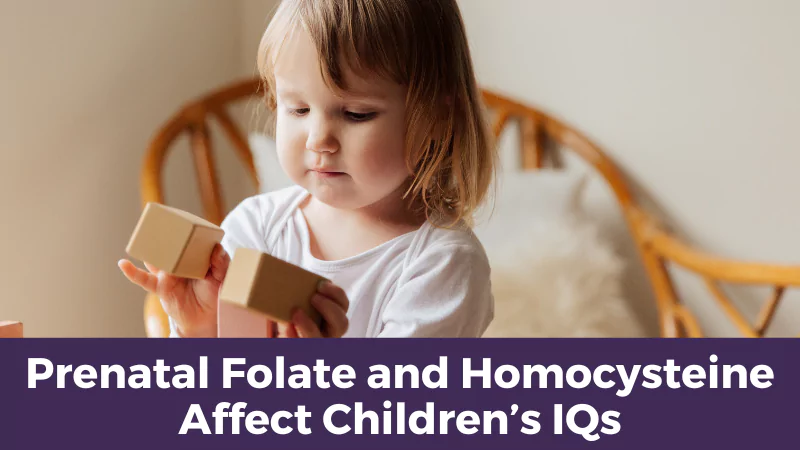
Prenatal Folate and Homocysteine Affect Children’s IQs:
The study found that children in the low folate group had smaller brain volumes than the normal-folate children, and that all regions of the brain were affected. These children also performed more poorly on cognitive tests related to language and visio-spatial processing.
Similarly, children subjected to high prenatal homocysteine levels had smaller brain volumes and significantly lower IQs at six years old (by an average of seven points). They also scored lower on language and visio-spatial processing tests. The one positive finding is that there was no association with psychological problems. Still, smaller brain size can limit intelligence and have long-lasting effects that inhibit functioning throughout life.
Fortunately, there’s more information available than ever to help you prepare for a healthy pregnancy. If you’re pregnant or trying to conceive, you may be interested in my free email course, 10 Days to a Healthy Pregnancy with MTHFR.
Yours in health,
Carolyn
[tcb-script async=”” id=”_simplero_landing_page_js_211735″ src=”https://mthfrsupportaustralia.simplero.com/page/211735.js”][/tcb-script]