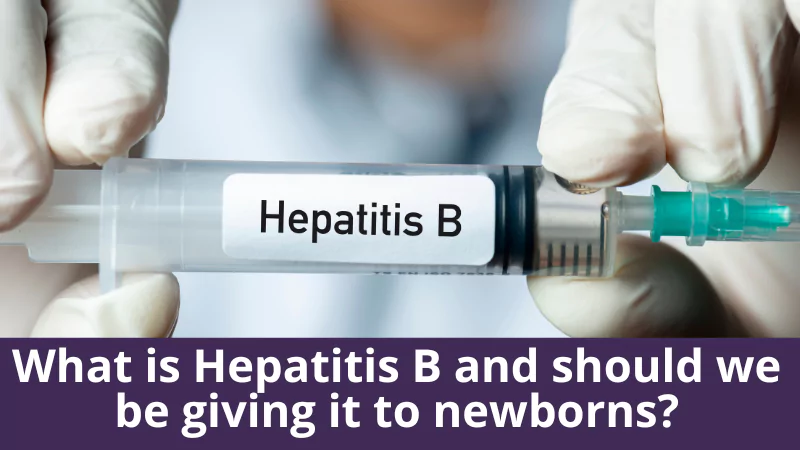
What is Hepatitis B and should we be giving it to newborns?
Hepatitis B injections are currently given to newborns, then again at 2 months, 4 months and 6 months. Many countries, including Norway don’t give this injection until 15 years of age and Denmark don’t give this at all.
The vaccine contains .5mg of Aluminium hydroxide (Engerix-B) and according to the manufacturer GlaxoSmithKlein, it should be given to people who are high risk:
- Health Professionals
- Those who receive frequent blood transfusions
- Patients on hemodialysis
- Patients with type 2 diabetes
- Personnel and residents of institutions
- Persons at increased risk due to sexual practices
- Persons who use injectable drugs
- Travellers to areas of high endemicity
- Infants born to Hepatitis B positive mothers
- Chronic Liver disease
There are studies that show that 4.5mcg/kg of body weight per day of aluminium caused impaired neurological development. The FDA (Federal Drug administration) in the US
recommends for preterm infants that aluminium should not exceed 4-5mcg/kg of the baby’s weight per day. So an 8LB or 4kg baby it would be 16-20mcg of aluminium, about 15 x less than what’s in the Hep B vaccine. The Engerix-B vaccine has 500mcg used here in Australia.
It doesn’t seem to make sense to be giving this at birth, UNLESS the child belongs to one of the high risk groups above. It makes sense to leave this vaccine until later in life when the child/adolescant is travelling to high risk areas and/or beginning sexual activity. It is crucially important that our childs immune system has a chance to develop BEFORE injecting them with 20 times the amount of aluminium that the FDA says is acceptable.
I’m definitely not saying don’t give the vaccine. Just wait. For those high risk people wait as long as possible.
What is Hepatitis B
Hepatitis B is a liver infection caused by the Hepatitis B virus (HBV). Hepatitis B is transmitted when blood, semen, or another body fluid from a person infected with the Hepatitis B virus enters the body of someone who is not infected. This can happen through sexual contact; sharing needles, syringes, or other drug-injection equipment; or from mother to baby at birth.
For some people, hepatitis B is an acute, or short-term, illness but for others, it can become a long-term, chronic infection. Risk for chronic infection is related to age at infection: approximately 90% of infected infants become chronically infected, compared with 2%–6% of adults. Chronic Hepatitis B can lead to serious health issues, like cirrhosis or liver cancer.
Symptoms
Many people with hepatitis B won’t experience any symptoms and may fight off the virus without realising they had it.
If symptoms do develop, they tend to occur two or three months after exposure to the hepatitis B virus.
Symptoms of hepatitis B include:
- flu-like symptoms, including tiredness, a fever, and general aches and pains
- loss of appetite
- feeling and being sick
- diarrhoea
- tummy (abdominal) pain
- yellowing of the skin and eyes (jaundice)
These symptoms will usually pass within one to three months (acute hepatitis B), although occasionally the infection can last for six months or more (chronic hepatitis B).
How do you get infected?
Hepatitis B can be spread by:
- a mother to their newborn baby, particularly in countries where the infection is common
- injecting drugs and sharing needles and other drug equipment, such as spoons and filters
- having sex with an infected person without using a condom
- having a tattoo, body piercing, or medical or dental treatment in an unhygienic environment with unsterilised equipment
- having a blood transfusion in a country where blood isn’t tested for hepatitis B – all blood donations in the UK are now tested for the infection
- sharing toothbrushes or razors contaminated with infected blood
- the skin being accidentally punctured by a used needle (needle stick injury) – this is mainly a risk for healthcare workers
- the blood of someone with hepatitis B getting into an open wound, cut, or scratch – in rare cases, being bitten by someone with hepatitis B can also spread the infection
Hepatitis B isn’t spread by kissing, holding hands, hugging, coughing, sneezing, or sharing crockery and utensils.
Who is at risk?
People at highest risk of hepatitis B include:
- people born or brought up in a country where the infection is common
- babies born to mothers infected with hepatitis B
- people who have ever injected drugs
- anyone who has had unprotected sex, including anal or oral sex – particularly people who’ve had multiple sexual partners, people who’ve had sex with someone in or from a high-risk area, men who have sex with men, and commercial sex workers
- close contacts, such as family members, of someone with long-term (chronic) hepatitis B infection
The risk of getting hepatitis B for travellers going to places where the infection is common is generally considered to be low if the activities mentioned above are avoided.
High Risk Areas
Hepatitis B is found throughout the world, but is particularly common in:
- sub-Saharan Africa
- east and southeast Asia
- the Pacific Islands
- parts of South America
- southern parts of eastern and central Europe
- the Middle East
- the Indian subcontinent
How do you prevent Hepatitis B infection?
A vaccine that offers protection against hepatitis B is available for people at high risk of the infection.
If you would like to know more about the childhood vaccines and how to identify high risk children, watch Dr. Carolyn Ledowsky on her Vaccination: MTHFR and high risk babies. How to identify them and what to do?
[row]
[col span=”6″ span__sm=”12″ divider=”0″ align=”left”]
[featured_box img=”5735″ img_width=”122″ pos=”left”]
Patient Webinar: Vaccinations and MTHFR
Cost: 24.95
[button text=”Buy now” letter_case=”lowercase” style=”outline” icon=”icon-shopping-cart” icon_pos=”left” link=”https://www.mthfrsupport.com.au/product/vaccinations-and-mthfr-for-patients/”]
[/featured_box]
[/col]
[col span=”6″ span__sm=”12″]
[featured_box img=”5652″ img_width=”122″ pos=”left”]
Practitioner Webinar: Vaccinations and MTHFR
Cost: $75.00
[button text=”Buy now” letter_case=”lowercase” style=”outline” icon=”icon-shopping-cart” icon_pos=”left” link=”https://www.mthfrsupport.com.au/product/vaccinations/”]
[/featured_box]
[/col]
[/row]
Sources:
- Hepatitis B – NHS Choices. (n.d.). Retrieved November 16, 2016, from
- Hepatitis B Information (2015). Retrieved November 16, 2016, from http://www.cdc.gov/hepatitis/HBV/index.htm
- ,
- https://www.ncbi.nlm.nih.gov/pmc/articles/PMC3509507/,
- https://www.gpo.gov/fdsys/pkg/FR-1998-01-05/pdf/98-76.pdf